
Rozhansky, I., Masseroni, M., Pisoni, R., Alshammari, S., Li, X., Ihn, T., Ensslin, K., McHugh, J., & Fal’ko, V. (2026). Refined density functional theory recipe and renormalization of band-edge parameters for electrons in monolayer MoS2 informed by the measured spin–orbit splitting. Nano Letters. https://doi.org/10.1021/acs.nanolett.6c00725
Abstract
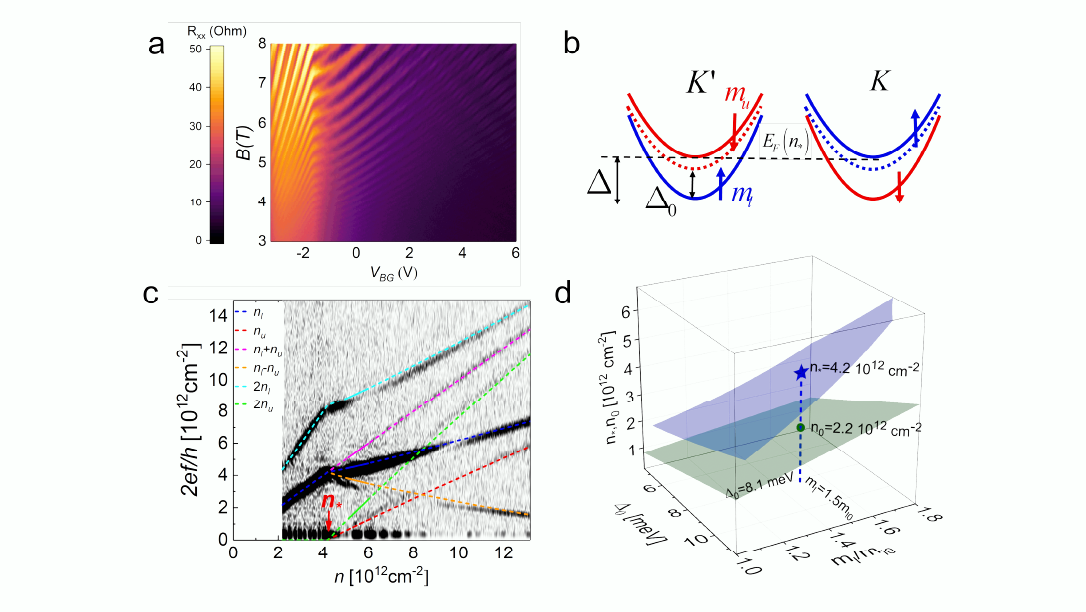
Conduction band-edge spin–orbit splitting (SOS) in monolayer transition metal dichalcogenides determines a competition between bright and dark excitons and sets conditions for spintronics applications of these semiconductors. Here, we report the SOS measurement for electrons in monolayer MoS2, found from the threshold density, n*, for the upper spin–orbit split band population, which exceeds by an order of magnitude the values expected from the conventional density functional theory (DFT). Theoretically, half of the observed SOS value can be attributed to the exchange enhancement of SOS in a finite-density electron gas, but explaining the rest requires refining the DFT approach. As the conduction band SOS in MoS2 is set by a delicate balance between the contribution of sulfur px and py orbitals and dz2–dxz and dz2–dyz mixing in molybdenum, we use a DFT + U + V framework, which includes both on-site (U) and intersite (V) Hubbard interactions for fine-tuning the orbital composition of the relevant band-edge states, which enables us to achieve a close agreement with the experiment.
Read the original article
Read the full article in arXiv