
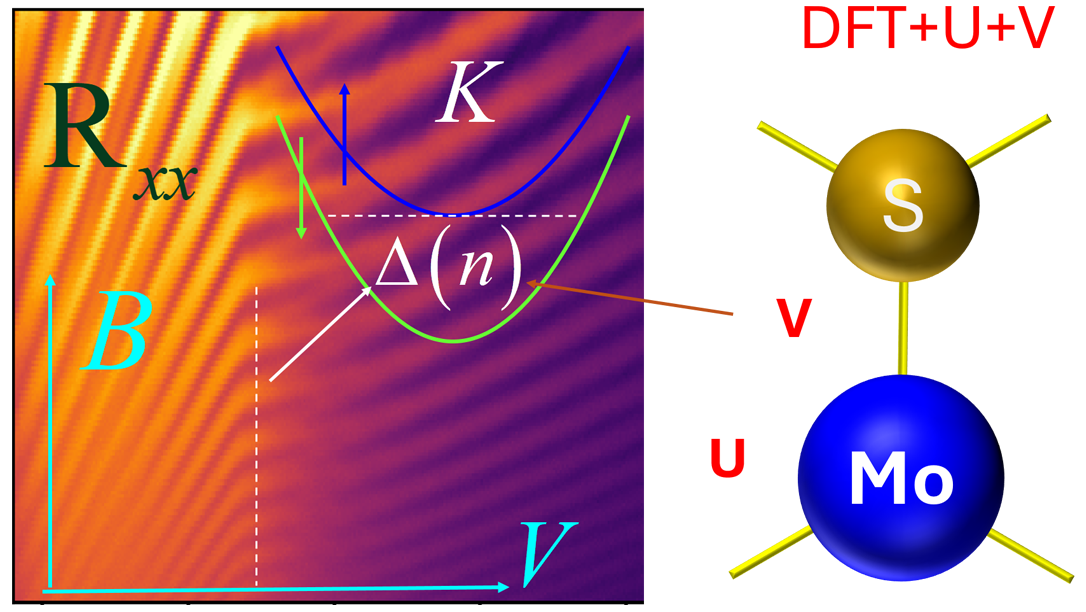
An International team of researchers, led by 2DFERROPLEX project members, have developed a new modelling tool for monolayer molybdenum disulphide (MoS2), resolving a long-standing discrepancy between predicted and measured electron behaviour. The team provides a new more accurate modelling tool for building future spintronic and optoelectronic devices.
Two-dimensional materials such as monolayer molybdenum disulphide (MoS₂) are regarded as promising building blocks for the next generation of electronics. Known for its environmental stability, high electron mobility, and prospects for wafer-scale growth, MoS₂ stands out among materials considered for spintronic and optoelectronic applications. For this reason, efficient modelling tools for understanding the properties of charge carriers in MoS₂ are strongly needed.
However, a significant obstacle has persisted for years: a mismatch between theory and experiment. The standard theoretical approach, density functional theory (DFT), predicted spin–orbit splitting (SOS) in the conduction band of MoS₂ of only a few millielectronvolts (meV), while experimental measurements pointed to values almost an order of magnitude larger. This gap has made it difficult to model accurately how charge carriers behave in this material.
Measuring the spin-orbit splitting
Now, researchers from the National Graphene Institute at The University of Manchester, including 2DFERROPLEX project members Igor Rozhansky and Vladimir Fal’ko, in collaboration with ETH Zürich and Northern Border University, report in a new article in ACS Nano Letters a refined tool for accurately modelling electron behaviour in transition metal dichalcogenides, a family of two-dimensional semiconductors.
The researchers analysed measurements on high-quality monolayer MoS₂ samples encapsulated by hexagonal boron nitride layers. Using Shubnikov–de Haas oscillations, a technique based on quantum oscillations in the material’s resistance, they identified the threshold density at which electrons begin to populate the upper spin–orbit split conduction band. This threshold density was almost an order of magnitude higher than expected from earlier DFT calculations and became the key experimental input for developing and testing the theoretical model.
A more accurate modelling “recipe”
The team found that a substantial part of the observed spin–orbit splitting is caused by interactions between electrons themselves, known as many-body effects.
To explain the remaining difference, the researchers introduced a refined modelling framework called DFT+U+V. This approach fine-tunes the orbital composition of the relevant electronic states by accounting for Hubbard interactions on and between the molybdenum and sulphur sites. Previous simulations underestimated the hybridisation between these atoms, causing different orbital contributions to cancel too strongly and leading to an artificially small spin–orbit splitting.
This new modelling recipe also improves the accuracy of other properties, such as the valence-band splitting and the material’s band gap.
“This new modelling tool provides an efficient route to obtain realistic band-edge parameters in monolayer MoS₂. This is important because spin–orbit splitting controls how electrons populate the spin-split bands and therefore affects the operation of future spintronic and optoelectronic devices,” said Igor Rozhansky, first author of the study and member of the 2DFERROPLEX project.
“Our research offers a new approach to bridging precision magnetotransport experiments, many-body theory and refined DFT calculations. The resulting method should be useful not only for MoS₂, but also for a broader family of two-dimensional semiconductors,” concluded Vladimir Fal’ko, researcher at The University of Manchester and also member of the 2DFERROPLEX project.
Original article
Rozhansky, I., Masseroni, M., Pisoni, R., Alshammari, S., Li, X., Ihn, T., Ensslin, K., McHugh, J., & Fal’ko, V. (2026). Refined density functional theory recipe and renormalization of band-edge parameters for electrons in monolayer MoS2 informed by the measured spin–orbit splitting. Nano Letters. https://doi.org/10.1021/acs.nanolett.6c00725