About us
Discover more about our objectives and approach
Traditional computers are increasingly limited in adressing the demands of modern applications like artificial intelligence, machine learning or edge computing. Neuromorphic systems offer a potential solution to improve computational efficiency, speed and energy consumption.
The Challenge
Smart devices need powerful processors, but current electronics are too energy-emanding and can’t handle edge requirements such as AI, machine learning or edge comptuing.
The objectives
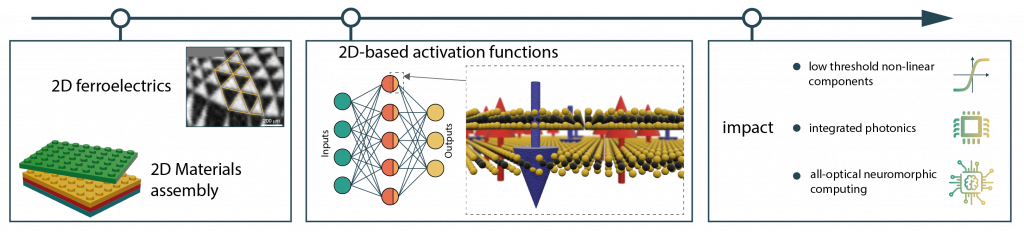
We aim to demonstrate how 2D heterostructures can be utilized as key components in all-optical neuromorphic systems. Our goal is to develop devices that operate at the speed of light, thus unlocking an unprecedented level of computational power while minimizing energy consumption. We aim to integrate these devices into photonic neural networks, creating the world’s first optical artificial neuron— fundamental building block for future neuromorphic systems.
The Approach
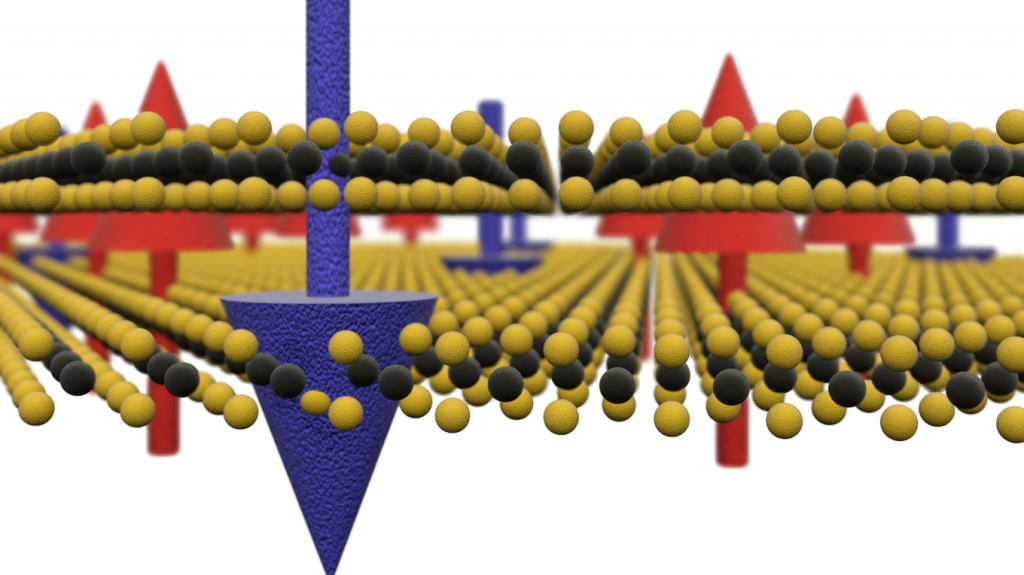
We’re developing atom-thick ferroelectric crystals controlled by light, not electricity. This all-optical approach eliminates signal conversions, potentially achieving nanowatt power levels—dramatically reducing energy use and processing time.
How it works
Ferroelectric materials are tiny switches flipping between two states. Light changes their polarization, affecting how they interact with more light—creating non-linear responses for brain-like computing without optical-electrical conversion.
The Science
Our team combines material science, photonics, AI, and neuromorphic computing expertise to create entirely new materials and devices, using AI-assisted design for scalability from lab to application.
Why It Matters
Traditional computers waste energy by separating memory and processing. Brain-inspired neuromorphic systems overcome this, and all-optical operation enables light-speed processing with minimal energy loss—a crucial step toward sustainable, ultra-efficient computing.