
Consortium
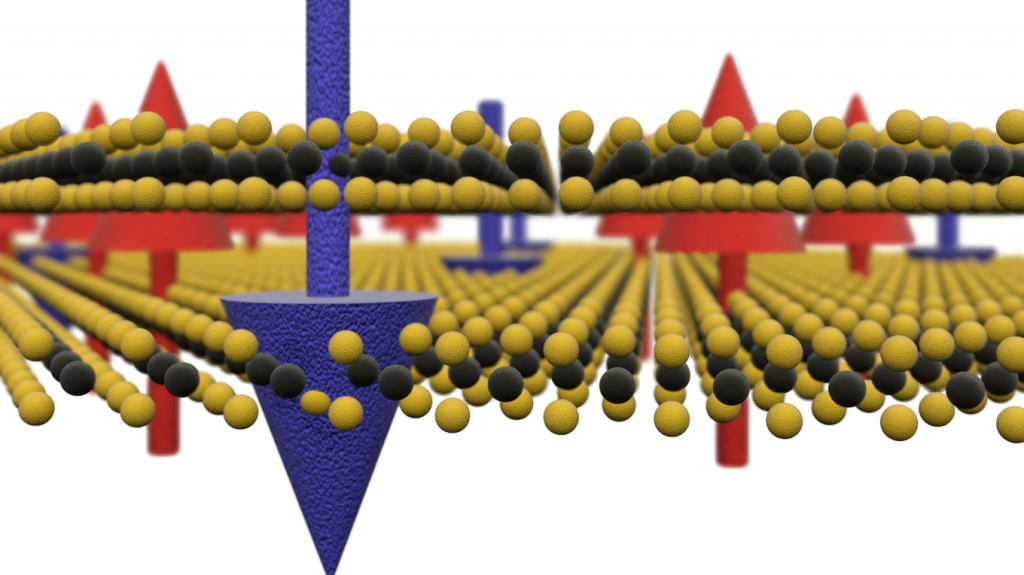
Our consortium is composed of leading academic institutions and industrial partners from across Europe, working together to unlock the full potential of 2D materials for next-generation of neuromorphic computing.
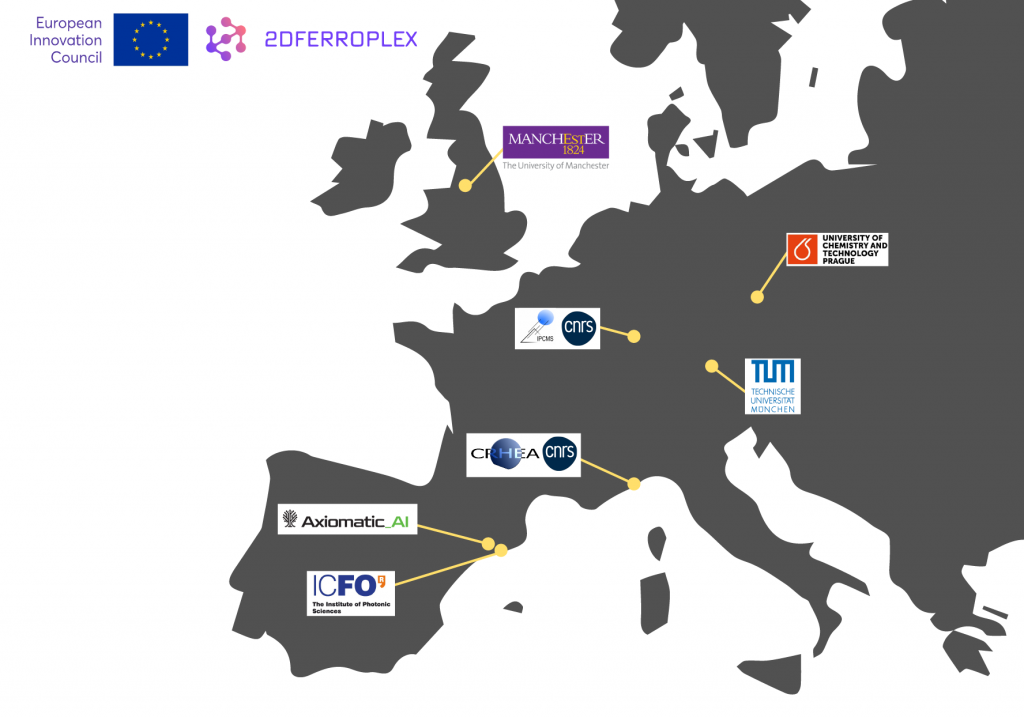

CRHEA – The French National Centre for Scientific Research (CNRS)
CNRS is one of the world’s leading research institutions, with more than 30,000 staff and over 1,000 research units covering all scientific disciplines. Its mission is to advance knowledge, foster innovation, and address major societal challenges through cutting-edge fundamental and interdisciplinary research, with strong participation in European programmes such as Horizon Europe. At the Research Center for Heteroepitaxy and its Applications (CRHEA), the CNRS team is led by Dr. Antoine Reserbat-Plantey, who brings over 15 years of experience in optical spectroscopies on 1D-2D materials. With existing collaborations across the consortium, he will develop state-of-the-art confocal spectroscopy techniques to measure excitons in ferroelectric 2D heterostructures. CRHEA provides advanced facilities including a μ-spectroscopy lab with 4K-optical cryostat, a 100 m² clean room for nanofabrication (EBL, SEM, RIE, evaporators, AFM), and a 200 keV STEM with 0.7 Å resolution.

The University of Manchester (UNIMAN)
The University of Manchester, founded in 1824, is the largest university in the UK with 11,000 staff and over 39,000 students, claiming 25 Nobel Laureates amongst its current and former staff. Ranked 41st globally (ARWU), Manchester hosts the largest single graphene research capability with over 200 researchers working across 2D nanomaterials, nanoelectronics, flexible electronics, spintronics, and sensors. Based at the National Graphene Institute (NGI), the Manchester team combines theoretical and experimental expertise. Prof. Vladimir Fal’ko leads multiscale modeling of van der Waals materials, including twisted ferroelectric TMDs. Prof. Roman Gorbachev brings expertise in nanoscale device fabrication and will develop the nanofabrication strategy and device prototyping for FERROPLEX.

The Technical University of Munich (TUM)
The Technical University of Munich (TUM) is one of Europe’s leading research universities, with over 52,000 students and excellence across engineering, natural sciences, medicine, and computer science. TUM researchers publish more than 10,000 scientific papers annually and attract over €500 million in research funding. The TUM group led by Jonathan Finley develops advanced optical spectroscopic methods to explore quantum-electronic, optical, and vibrionic phenomena in semiconductor nanomaterials. Their research spans quantum photonics, metrology and sensing, novel opto-electronic systems, and atomically thin 2D-materials and heterostructures.

Institute for Photonic Sciences (ICFO)
ICFO is a leading photonics research center located in Barcelona’s Mediterranean Technology Park, hosting over 300 researchers in 26 research groups across 60 state-of-the-art laboratories. ICFOnians have been awarded 15 ICREA Professorships and 27 European Research Council grants, and the institute consistently ranks among the world’s top research centers. ICFO actively participates in the European Technological Platform Photonics21 and fosters entrepreneurial activities and spin-off creation. Led by Prof. Frank Koppens, the ICFO team specializes in photonic devices and 2D materials, with expertise in on-chip integration, single-photon emitters, and exciton dynamics in TMDs. Within FERROPLEX, ICFO will develop near-field scanning optical microscopy (s-SNOM) techniques to study ferroelectric domains and contribute to optical control of neuromorphic components. ICFO provides a 300 m² clean room with advanced nanofabrication tools (EBL, FIBs, RIE, ALD, PVD), a 2D heterostructure fabrication lab with transfer setups and CVD growth chambers, and multiple cryo-optical and s-SNOM setups.
The University of Chemistry and Technology of Prague
The University of Chemistry and Technology, Prague (UCT Prague) is a leading European institution specializing in chemistry, chemical engineering, materials science, and nanotechnology. It ranks among the top Czech universities for science and research, with researchers obtaining prestigious grants including ERC funding. The university supports cutting-edge research through modern central laboratories and strong industry collaborations. The UCT Prague team is led by Prof. Zdeněk Sofer, whose expertise spans crystal growth, synthesis, and exfoliation of novel 2D materials. Within FERROPLEX, the team develops high-quality 2D materials for exfoliation. UCT Prague provides exceptional facilities including over 30 furnaces for crystal growth, CVD/PVD/MBE/ALD systems, cleanroom nanofabrication tools, and advanced characterization equipment.

ICPMS-University of Strasbourg (UNISTRA)
IPCMS, a joint laboratory of CNRS and Université de Strasbourg, specializes in quantum science and nanomaterials research. The institute supports cutting-edge research through state-of-the-art facilities and strong expertise in low-dimensional materials and device physics. Led by Prof. Jean-François Dayen, the IPCMS team focuses on 2D materials devices. Within FERROPLEX, the team will develop multistate memory devices and emulate neuromorphic plasticity using sliding ferroelectric domains. IPCMS provides the STnano 180 m² cleanroom nanofabrication platform and the 2DLab facility, equipped with transfer glovebox stations, cryo-opto-electronic transport systems, μ-Raman spectroscopy, piezoresponse force microscopy (PFM), and transmission electron microscopy (TEM).
Axiomatic AI (EU)
Axiomatic AI (subsidiary of Axiomatic AI USA) is an innovative industrial partner specializing in Automated Interpretable Reasoning (AIR) models with the aim to accelerate science&engineering. Founded in 2024 by a team of world-renowned engineers, physicists, and computer scientists from institutions like MIT, University of Toronto, and ICFO, AAI focuses on addressing real-world challenges in electronics, integrated photonics, engineering, and physics. Backed by Kleiner Perkins, AAI aims to advance technological progress by making complex information more intelligible and driving rapid discoveries in science and industry.